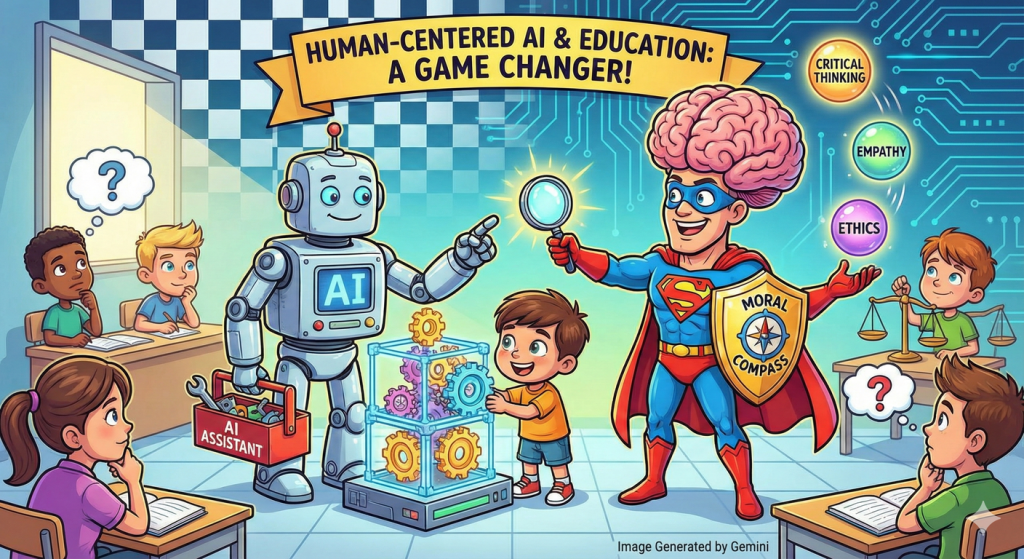
A First Look at the AI Revolution in the Classroom
A lot of people are talking about AI in schools, and their feelings range from excitement to worry. The news is full of bold predictions, and teachers are trying to figure them all out. But does the story that AI will replace teachers miss the bigger, more important picture?
What if the biggest changes aren’t in the teachers, but in how students learn? This article perspectives goes beyond the hype to show five important and sometimes surprising things that can be learned from professional development on “Building Critical and Creative Digital Competencies.” These ideas show that AI is more than just a new tool; it is changing how people learn and teach in very important ways.
——————————————————————————–
1. It’s Not a Replacement, It’s a New Partnership: The Teacher-AI-Student Dynamic
The most important change isn’t that AI will take over a teacher’s job; it’s that the way teachers and students talk to each other will change into a new “teacher-AI-student” relationship. AI is good at making content, processing a lot of data, and helping people make decisions. This gives us new ways to run schools and teach.
The teacher’s job is more important than ever in this new model. The teacher is not just someone who gives information; they are also someone who gives advice, helps, and sets moral standards. They use AI as a powerful tool to plan the learning experience, but they always make sure that human connection and critical oversight are at the heart of the process.
The Teacher’s Guide: Have everyone in the class use an AI tool to make a basic project outline. Then, ask things like, “What perspective is missing from this person?” or “What can we do to make this more creative?” to get people to talk about how to make it better. This quick exercise makes AI the starting point instead of the final word, which changes things right away.
——————————————————————————–
2. Digital Literacy Was the Foundation, AI Literacy Is the Future.
The main goal for a long time has been digital literacy, or being able to use digital tools. But in the age of AI, this isn’t enough anymore. Older technologies, such as ICT, mostly helped with everyday tasks and moving data around. AI is very different. It can act like a person, process a lot of information, create new content, and help people make decisions by using predictive analysis.
AI Literacy is a group of skills that are more important and specific for living in this new world. You need to know how to use an AI tool, but you also need to know what it can and can’t do and what the moral implications are.
Digital literacy is the most important skill for using technology in a nutshell. The next step is AI Literacy, which builds on that skill. It is important to deal with the unique aspects, life-changing chances, and complicated risks that come with AI. It puts a lot of pressure on ethics, free will, and critical thinking.
The Teacher’s Playbook: Look for AI in your classroom. Tell your students to list three things they use every day that use AI, such as grammar checkers and feeds on social media. Tell them to tell you what each one does and guess one good thing and one bad thing that could happen. This makes the conversation less about using tools and more about getting to know them.
——————————————————————————–
3. The Real Danger Isn’t Job Loss—It’s the Loss of Critical Thinking
It’s more likely that relying too much on AI will make important human skills weaker than losing your job. Students might not want to think deeply, do research, or check their work when AI gives them quick answers. The two illustrated stories that showed this perfectly:
* Mrs. Rani, a history teacher, found a beautiful AI-made video about a hero from her area. She was interested, but she saw a lot of claims that weren’t backed up by strong historical sources. She was worried that students were using the video as their main source without looking into it first, which she thought would make it harder for them to think critically.
* Another teacher, Mr. Budi started using an AI learning assistant, he noticed a worrying trend as a history teacher. His students stopped reading and talking about things. They just asked the AI for answers instead. He even learned that making tests with AI could be dangerous because it could add a “wrong fact” to a question. After he learned this, he changed how he taught. AI was no longer just a machine that answered questions; it was a way to speak out against things. Students now had to check the AI’s claims against other sources and talk about the human values that shaped events in the past.
The Educator’s Playbook: Change the way you do one research project. Instead of telling students to use AI to find an answer, tell them to come up with two different AI answers to the same question. They must compose a brief essay contrasting the two responses and indicating which is more accurate, biased, or comprehensive. They should back up what they say with proof from primary sources. We used to think of AI as a way to get answers, but now we can say bad things about it.
——————————————————————————–
4. The Most Important AI Skill for Teachers Isn’t Technical, It’s a “Human-Centred Mindset”
People might think that teachers need to know how to use technology now that AI is here, but what they really need is a way of thinking that focuses on people. This framework says that schools must always put the rights and progress of people first when they use AI. This rule says that AI should always be controlled by people. So, teachers need to help students think critically about the pros and cons of AI tools while also making sure that people are always responsible for what they do.
This way of thinking isn’t just a skill; it’s a way to get better. A teacher checks an AI-made quiz against the Acquire level curriculum to make sure it isn’t unfair. Next, they go to the Deepen level, where they might talk about how the new AI tool is getting too much attention in class. At the Create level, a teacher uses AI to make different versions of a lesson for each student. This makes the classroom more fair and welcoming to all.
The Teacher’s Guide: Start at the “Acquire” level this week. Use an AI tool to make a lesson plan or a short summary of a reading for a class that is coming up. You can’t just use it; you have to spend ten minutes writing down what you think about it. Find one thing that is biased, one thing that is wrong, and one place where you need to be more human. This simple thing makes the muscle of critical oversight stronger.
——————————————————————————–
5. The Teacher’s New Role: From Content Provider to Ethical Guide
The teacher’s job is changing a lot as AI does more and more of the work of making content and getting information to people. They are no longer just “providers of material.” Now they are important moral guides and people who help others think critically.
This is a great example of moral guidance that Pak Budi has received. He was teaching them how to fight algorithmic bias when he told them to check AI’s claims. When he talked about “human values,” he was showing what it means to think like a human. To be a good digital citizen in the age of AI, you need to know about copyright, data privacy, and honesty in school. In his classroom, people began to talk about these things.
Digital literacy teaches us how to make content that is honest and how to use critical thinking to solve problems while still caring about other people.
The Teacher’s Playbook: For the first 15 minutes of the next class, do a “AI ethics case study.” For instance, “A student uses an AI image generator to make art.” Is this a new piece of work? “Who is the artist?” As the moderator of an important ethical conversation, not as the judge, help set up a structured debate.
——————————————————————————–
Conclusion: Guiding, Not Replacing
AI is a technology that will change the game, but its real value in education comes from the teacher who uses it and is skilled, critical, and morally aware. In the future, education won’t be about taking the place of people; it will be about helping them. The job of a teacher is getting harder and more important all the time. They need to help students learn how to think critically and morally, which technology can’t do by itself.
The big question for us now is not whether we will use AI, but how we will do it. How can we, as teachers and lifelong learners, start teaching this human-centered way of using AI in our schools and communities right away?